Finding the Boat
A position fix estimates an unknown position from observations tied to known reference positions. NautiPy works with:
- a true bearing measured at the unknown boat toward a reference; and
- a shortest WGS84 surface range between the boat and a reference.
The observations can be all bearings, all ranges, or a mixture. Their geometry determines whether the boat is uniquely located.
Bearings: directions from the boat
Imagine looking from the boat toward a known lighthouse and measuring its true bearing. A second landmark supplies another directional constraint. Their intersection is a form of resection.
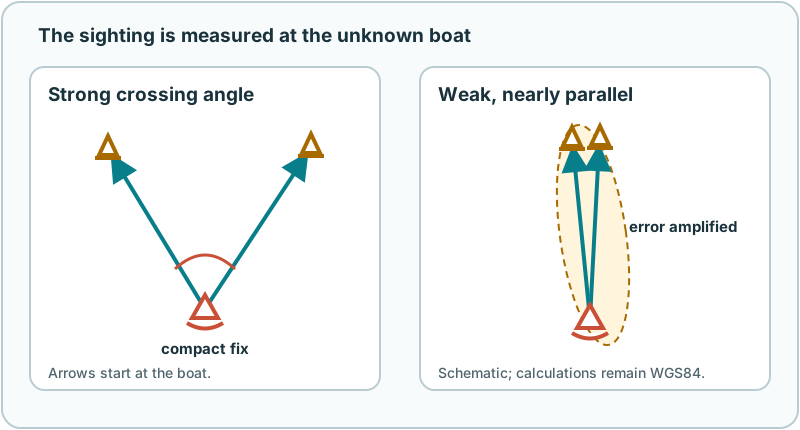
The direction convention is important:
It is not the bearing from the reference toward the boat. On an ellipsoid, you should not reverse an initial bearing by blindly adding 180°.
from nautipy import BearingObservation, Position

lighthouse = Position(50.116135, 8.670277)
observation = BearingObservation(
    lighthouse,
    bearing=164.71,     # true degrees at the boat toward the lighthouse
    uncertainty=0.05,  # one standard deviation in degrees
)
When bearing lines cross at a healthy angle, small angular errors tend to move their intersection modestly. Nearly parallel directions can move it a long way: that is weak geometry.
Ranges: circles around references
A measured range says that the boat lies a given surface distance from a known reference. In a local schematic this looks like a circle.
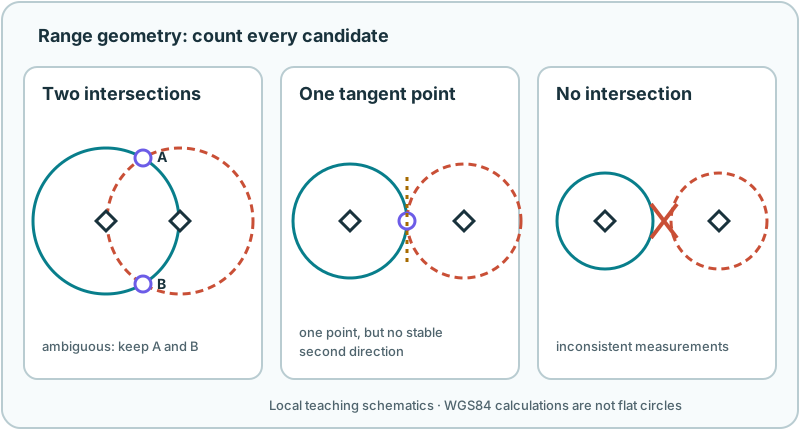
Two range circles may:
- cross twice, leaving two possible positions;
- touch once, producing a tangent mathematical candidate;
- remain apart or one inside the other, producing no candidate; or
- coincide, failing to isolate any position.
This idea is often called trilateration. A third independent observation usually selects one of the two intersections.
You can expose the exact two-observation geometry:
from nautipy import (
    Position,
    RangeObservation,
    distance,
    two_range_candidates,
)

boat_for_example = Position(50.12257, 8.66570)
first_reference = Position(50.116135, 8.670277)
second_reference = Position(50.112836, 8.666753)

first = RangeObservation(
    first_reference,
    distance(boat_for_example, first_reference),
    uncertainty=2.0,
)
second = RangeObservation(
    second_reference,
    distance(boat_for_example, second_reference),
    uncertainty=2.0,
)

candidates = two_range_candidates(first, second)
print(candidates.status)
print(candidates.positions)
The diagram is flat and schematic. NautiPy calculates candidate positions with WGS84 surface distances.
Why uncertainty is required
A bearing residual is measured in degrees; a range residual is measured in metres. Adding their raw squares would give arbitrary weight to the choice of units.
Each observation therefore requires a finite, positive one-standard-deviation uncertainty in its natural unit. NautiPy divides each residual by that uncertainty before fitting. A 2 m range miss and a 0.2° bearing miss both count as one standardized unit if their declared uncertainties are 2 m and 0.2°.
The model treats uncertainties as independent, absolute Gaussian standard deviations. It does not estimate shared biases or correlations.
Solving a mixed fix
This example creates self-consistent observations from a teaching position, then asks NautiPy to recover a fix:
from nautipy import (
    BearingObservation,
    Position,
    RangeObservation,
    distance,
    initial_bearing,
    solve_fix,
)

teaching_position = Position(50.12257, 8.66570)
references = (
    Position(50.116135, 8.670277),
    Position(50.112836, 8.666753),
    Position(50.110347, 8.659873),
)

bearings = tuple(
    BearingObservation(
        reference,
        initial_bearing(teaching_position, reference),
        uncertainty=0.2,
    )
    for reference in references[:2]
)
ranges = (
    RangeObservation(
        references[2],
        distance(teaching_position, references[2]),
        uncertainty=3.0,
    ),
)

result = solve_fix(bearings=bearings, ranges=ranges)
print(result.status)
print(result.position)
print(result.residuals)
print(result.warnings)
solve_fix searches a regional disk. By default, its center is derived
deterministically from the references and its radius is 500 km. You can supply
search_center and search_radius when your problem has a justified domain.
The domain is part of the result’s meaning: uniqueness is claimed only inside
that disk and within NautiPy’s deterministic multistart search.
A candidate is not yet a trustworthy fix
Exact two-observation helpers classify mathematical candidates as unique, ambiguous, absent, or degenerate. The general solver goes further:
- it will not select one of several comparable positions;
- it requires the local geometry to constrain two dimensions stably;
- it reports residuals in natural and standardized units; and
- it attaches local uncertainty only to a unique, converged, full-rank fix.
A tangent range intersection, for example, is one mathematical candidate but
does not constrain two local axes stably. It can be UNIQUE as candidate
geometry and DEGENERATE as a solved fix.
Learn how to judge the complete result →
Boundaries and limitations
- Bearings are true initial bearings at the boat; NautiPy does not apply magnetic variation.
- Ranges are shortest WGS84 surface distances, not slant ranges through three-dimensional space.
- The model assumes a stationary two-dimensional problem and independent errors.
- It does not account for refraction, current, platform motion, time correlation, or common sensor bias.
- The regional fixer is not intended for global or near-antipodal networks.
For the exact model, thresholds, and failure states, see the position-fix behavior specification.
Navigation safety
A plausible coordinate can still come from ambiguous, weak, biased, or inconsistent observations. Inspect the complete result and use appropriate independent navigation safeguards.
Learn more
- Position fixing surveys the general navigation idea.
- Resection and trilateration introduce bearing- and range-based geometry.
- The NGA’s American Practical Navigator is a primary practical reference for navigation concepts.
- Karney’s Algorithms for geodesics describes the WGS84 geodesic calculations behind predicted observations.
Next: Can You Trust the Fix?.