Can You Trust the Fix?
A solver can stop successfully and still leave the underlying navigation question unanswered. Perhaps two positions fit almost equally well. Perhaps the observations constrain east–west motion but barely constrain north–south motion. Perhaps the measurements disagree with their claimed uncertainties.
NautiPy’s FixResult separates four questions:
- Outcome: did the search find one acceptable in-domain basin?
- Geometry: do the observations constrain both local dimensions?
- Fit: do predictions agree with observations at the declared noise scale?
- Uncertainty: how does local measurement uncertainty map into position?
Start with status, not the coordinate
FixStatus.CONVERGED is the only successful status.
| Status | Meaning |
|---|---|
CONVERGED |
One in-domain position converged with rank-two local geometry. |
AMBIGUOUS |
Multiple materially distinct, statistically comparable positions fit. |
DEGENERATE |
The observations do not stably constrain both local dimensions. |
NO_SOLUTION |
No valid solution exists in the declared search domain. |
NON_CONVERGED |
The numerical search ended without a valid converged basin. |
Every unsuccessful result has position=None. An ambiguous result instead
exposes its deterministic competing_positions; NautiPy does not choose one
because its numerical cost is microscopically lower.
result = solve_fix(ranges=ranges)

if not result.success:
    print(result.status, result.message)
    print(result.competing_positions)
Residuals put the observations on trial
At a trial position, NautiPy predicts every supplied observation.
- Bearing residual: wrapped
predicted − observedin[-180°, 180°). - Range residual:
predicted − observedin metres. - Standardized residual: natural residual divided by the observation’s standard deviation.
In compact notation,
A positive range residual means the predicted range is too long. A positive bearing residual means the predicted direction is clockwise from the observed direction.
for item in result.residuals:
    print(
        item.observation,
        item.predicted,
        item.residual,
        item.standardized_residual,
    )
objective is the sum of squared standardized residuals. rms is their
dimensionless root-mean-square value; bearing_rms and range_rms retain
natural units where applicable. An RMS above 2 produces a warning because
residuals are large relative to the uncertainties supplied.
This interpretation depends on the uncertainty model being reasonable. Tiny declared uncertainties can make modest residuals look severe; inflated uncertainties can hide a poor physical fit.
Rank and condition number describe geometry
Near the solution, a Jacobian records how standardized predictions change with small east and north movements.
- Rank 2 means both local directions are constrained.
- Missing rank, or an extremely ill-conditioned system, is degenerate.
- The condition number compares the strong and weak local directions. Near 1 is balanced; a large value means errors can be greatly amplified in one direction.
NautiPy warns above a condition number of 1,000 and classifies geometry as degenerate when rank is missing or the condition number exceeds 1,000,000. Those thresholds diagnose the local numerical model; they do not replace domain knowledge.
Nearly parallel bearings and nearly tangent range circles are familiar examples of weak geometry.
Degrees of freedom and reduced chi-square
The fixer estimates two local coordinates. With n scalar observations, the reported degrees of freedom are:
When this number is positive, reduced_chi_square is:
It helps compare the total standardized mismatch with the assumed independent Gaussian errors. It is absent for a just-determined two-observation problem, where no residual degrees of freedom remain to assess fit.
Do not read one realization as a universal pass/fail test. Correlation, bias, non-Gaussian errors, and a wrong physical model can all invalidate the simple statistical interpretation.
The local 95% uncertainty ellipse
For a unique, converged, full-rank result, NautiPy linearizes the observation model around the selected position.
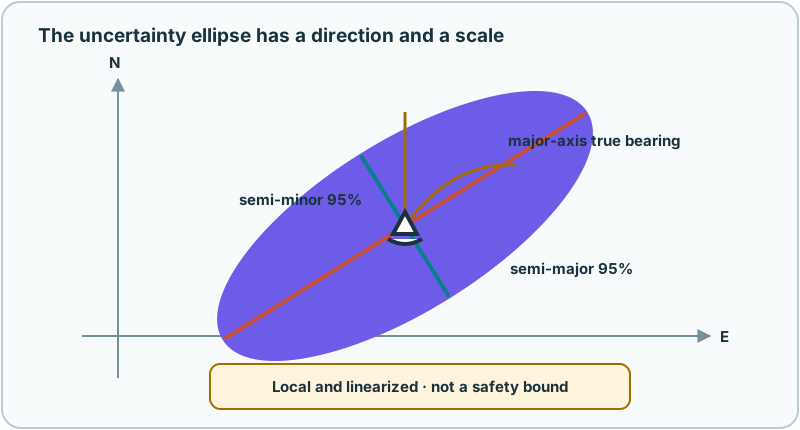
FixUncertainty reports:
- a 2 × 2 east/north covariance matrix in square metres;
- east and north standard deviations in metres;
- their correlation;
- semi-major and semi-minor axes of a local 95% ellipse in metres; and
- the major-axis true bearing in
[0°, 180°), unless the ellipse is isotropic.
if result.uncertainty is not None:
    uncertainty = result.uncertainty
    print(uncertainty.east_standard_deviation)
    print(uncertainty.north_standard_deviation)
    print(uncertainty.semi_major_95)
    print(uncertainty.semi_minor_95)
    print(uncertainty.major_axis_bearing)
The covariance is C = (JᵀJ)⁻¹ under the declared absolute
observation uncertainties. NautiPy does not rescale it by the fitted residual
variance.
The ellipse is a local, linearized confidence description, not a safety boundary. It is withheld for ambiguous, non-converged, rank-deficient, or numerically invalid geometry. Large uncertainty relative to the search domain also produces a warning.
Remember the search domain
The fixer searches a closed WGS84-distance disk. A result near its boundary warns that the chosen domain matters. A solution outside the disk is not projected onto the edge, and a uniqueness claim never extends to the entire globe.
When choosing a domain:
- center it from defensible prior knowledge or accept the deterministic reference-derived default;
- make it large enough for the physical problem, but not a substitute for a global solver; and
- record it alongside the result because it limits the claim.
A compact review checklist
print("status:", result.status)
print("message:", result.message)
print("warnings:", result.warnings)
print("rank:", result.rank)
print("condition:", result.condition_number)
print("standardized RMS:", result.rms)
print("reduced chi-square:", result.reduced_chi_square)
print("competing positions:", result.competing_positions)
print("uncertainty:", result.uncertainty)
Ask whether the references and observations are independent, correctly timed, in the documented units, and free of known common bias. Diagnostics cannot detect every bad assumption.
For exact public thresholds and result invariants, see the position-fix behavior specification.
Navigation safety
Neither convergence nor a 95% ellipse certifies a safe position. Maintain independent checks appropriate to the vessel, environment, and consequences.
Learn more
- Least squares introduces the fitting principle.
- Condition number explains sensitivity to input errors.
- Covariance matrix and confidence region introduce the uncertainty language.
- SciPy’s bounded nonlinear least-squares reference documents the numerical optimizer used by NautiPy.
- NIST’s Uncertainty of Measurement resources provide primary guidance on stating measurement uncertainty.
Try the Fix Lab.