Fix Lab
The Fix Lab compares position-fixing situations without turning your browser into a second solver. Every scenario is calculated ahead of time through NautiPy’s public API. JavaScript only switches between the stored results and draws their local schematic.
Interactive scenarios load here when JavaScript is available.
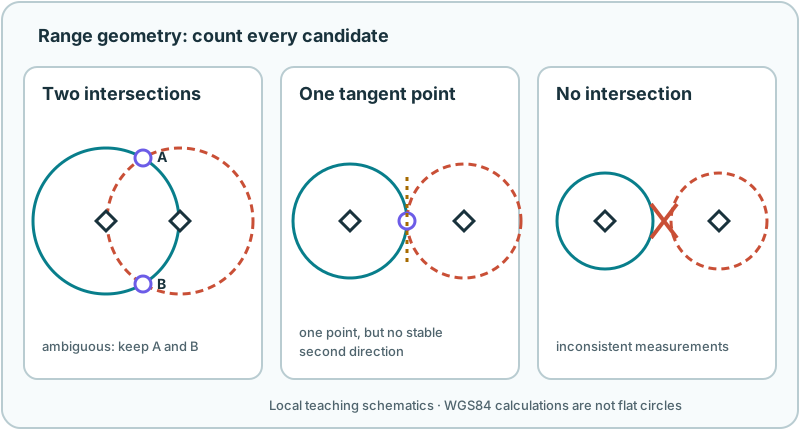
The static schematic remains the complete fallback. The interactive comparison appears here when its small local data file and JavaScript load successfully.
The visual is a local teaching schematic. Its east/north axes, circles, lines, and ellipses help compare geometry; they are not a nautical chart. Fixture positions, predicted observations, residuals, and uncertainty are calculated on WGS84.
Eight experiments
Two ranges: why two answers are normal
Two range constraints commonly cross twice. Both candidates satisfy the same two measurements, so choosing the visually convenient one would be inventing information. NautiPy reports ambiguity.
Watch for:
- two separated candidate boats;
- equally valid range constraints; and
AMBIGUOUS, not a selected position.
A third range: adding independent evidence
A third, well-placed range generally favors one of the two intersections. It also creates one residual degree of freedom, so inconsistent data can begin to show itself in fit metrics.
Watch for:
- one selected position;
- rank-two geometry; and
- residuals that remain small relative to the declared range uncertainties.
Tangent ranges: one point can still be weak
Two range circles that merely touch have one mathematical candidate, but a small measurement change can make them cross twice or not meet at all. The candidate helper calls the point unique and warns about rank deficiency; the general fixer calls the geometry degenerate.
Watch for the difference between candidate count and a stable two-dimensional fix.
Strong bearing geometry
Bearings toward separated references cross at a healthy angle. A small angular change moves the intersection only modestly.
Watch for a compact uncertainty ellipse and a condition number nearer 1 than in the weak case.
Weak bearing geometry
Nearly parallel bearing constraints can intersect, yet leave one local direction poorly determined. A small bearing error can move the fix a long distance along that weak direction.
Watch for:
- an elongated ellipse;
- a large condition number or geometry warning; and
- the difference between “the optimizer stopped” and “the geometry is good.”
Noisy mixed observations
Bearings and ranges can be fitted together only after each residual is divided by its uncertainty. This scenario makes the natural units visible beside the standardized residuals.
Watch how a metre residual and a degree residual become comparable only after standardization.
Uncertainty changes influence
An observation with a smaller declared standard deviation has more influence on the standardized least-squares objective. This experiment changes uncertainty while keeping the physical units explicit.
Watch the fitted position move toward the observation assigned the tighter uncertainty. That weighting is meaningful only when the supplied uncertainty model is defensible.
Larger uncertainty, wider ellipse
The final scenario focuses on the 95% confidence ellipse. Its long axis points toward the locally weak direction. It summarizes the supplied independent standard deviations and the linearized model near the solution.
It is not a containment guarantee or safety boundary.
Recreate the idea in Python
This complete example constructs exact ranges to a teaching position and adds a third reference to resolve the usual two-range ambiguity:
from nautipy import (
    Position,
    RangeObservation,
    distance,
    solve_fix,
    two_range_candidates,
)

boat_for_example = Position(50.12257, 8.66570)
references = (
    Position(50.116135, 8.670277),
    Position(50.112836, 8.666753),
    Position(50.110347, 8.659873),
)
ranges = tuple(
    RangeObservation(
        reference,
        distance(boat_for_example, reference),
        uncertainty=2.0,
    )
    for reference in references
)

two_range_result = two_range_candidates(ranges[0], ranges[1])
print(two_range_result.status, two_range_result.positions)

fix_result = solve_fix(ranges=ranges)
print(fix_result.status, fix_result.position)
print(fix_result.rank, fix_result.condition_number)
print(fix_result.uncertainty)
The fixture generator follows the same principle: use public NautiPy operations, save ordinary numeric results, then let the browser present them. The web page does not reproduce GeographicLib or the SciPy optimizer.
Questions to ask as you compare
- How many positions fit the observations?
- Are both local directions constrained?
- Are residuals small relative to the stated uncertainties?
- Does the search domain limit the uniqueness claim?
- Is the local uncertainty small enough for the intended purpose?
- Which real-world effects are absent from the model?
Use the result-reading guide for the meaning of every diagnostic and Finding the Boat for the underlying geometry.
Limitations
- All scenarios are precomputed examples, not live measurements.
- Screen coordinates are local schematics and may exaggerate small differences for legibility.
- Bearings are true bearings at the unknown boat toward references.
- Range rings represent WGS84 surface distance; a drawn circle is not a claim that Earth is flat.
- The uncertainty model assumes independent Gaussian observation errors and no shared bias.
Navigation safety
The lab is for learning. It does not accept live navigation data and must not be treated as a chart, receiver, alarm, or certified fixing system.
Learn more
- Trilateration introduces range-intersection geometry.
- Resection introduces position estimation from known references.
- Confidence region provides background for the ellipse.
- NautiPy’s position-fix behavior specification defines the calculations represented by the fixtures.